
 Instagram
  Youtube
  Whatsapp
 How AI and Automation Are Changing Digital Marketing Workflows
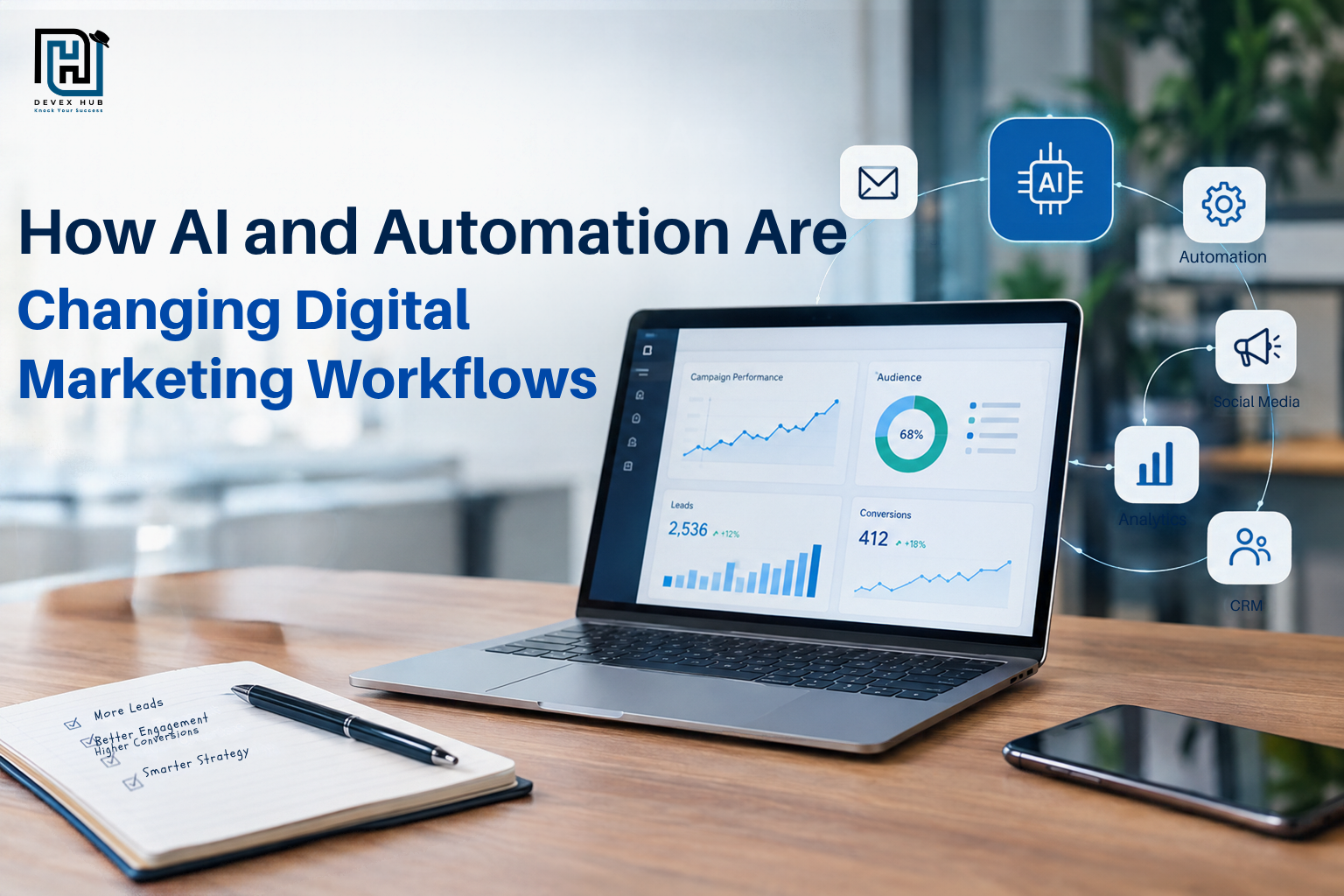
Digital marketing workflows are becoming more connected as businesses adopt artificial intelligence, automation, integrations, and data-driven tools. Marketing teams that once handled repetitive tasks manually can now use technology to organize information, manage campaigns, qualify leads, and improve customer communication.
The biggest change is not simply that more tasks are becoming automated. Modern tools can connect different marketing systems and use AI to help teams understand information and manage more complex workflows.
So, how is this changing digital marketing?
From Traditional Automation to AI-Powered Workflows
Traditional marketing automation is useful for repetitive and predictable activities such as sending emails, updating records, scheduling content, or notifying a team member when a new lead arrives.
Modern AI-powered workflows can go further by helping interpret information before an action takes place.
For example, when a potential customer submits an enquiry, an AI-supported workflow can analyze the message, identify the type of request, organize the information in a CRM, and trigger an appropriate follow-up process.
This creates a more connected workflow while still allowing marketing teams to remain involved where human judgment is needed. Devex Hub helps businesses use AI and automation to build connected marketing workflows that support these processes.
How AI Agents Are Changing Marketing
One of the newer developments in automation is the growth of AI agents.
Unlike basic automation tools that usually perform individual predefined tasks, AI agents can be designed to work through multiple steps using connected tools and information.
In digital marketing, AI agents can assist with activities such as:
- Reviewing incoming enquiries
- Summarizing customer conversations
- Categorizing potential leads
- Supporting content workflows
- Preparing campaign information
- Updating connected systems
- Assisting with customer follow-ups
AI agents are still tools rather than replacements for marketing professionals. Human review remains important for brand communication, strategy, sensitive information, and important customer decisions.
Connecting Different Marketing Systems
Modern businesses often use several platforms for their marketing activities. A website may connect with a CRM, email platform, analytics software, advertising tools, and customer-support systems.
Managing these platforms separately can create unnecessary manual work.
Integrations allow information to move between connected systems, creating a smoother workflow.
A modern marketing process might connect:
Website → CRM → AI analysis → Customer communication → Sales team → Analytics
This approach can help businesses reduce repetitive data entry and keep important customer information organized.
Businesses looking for AI integration services in Mohali can use these technologies to connect AI tools with existing business and marketing systems rather than introducing completely separate processes.
AI-Powered Lead Qualification
Lead qualification is another area where AI can support marketing teams.
Instead of manually reviewing every enquiry, businesses can use AI to analyze information such as the customer's message, requirements, previous interactions, and other available data.
A workflow can then help categorize enquiries according to predefined business criteria.
For example, a detailed service enquiry may be sent to a sales representative, while someone requesting general information may receive an educational follow-up.
This can help teams spend more time on meaningful conversations instead of manually sorting every enquiry.
Personalization Is Becoming More Practical
Personalized marketing has existed for years, but AI and automation are making it easier to manage at scale.
Businesses can use customer information and interactions to create more relevant experiences through:
- Personalized email sequences
- Audience segmentation
- Content recommendations
- Product or service suggestions
- Follow-up communication
The goal should not be personalization simply for the sake of using AI. Businesses should use customer information responsibly and only when it improves the experience.
AI and the Changing SEO Workflow
SEO is also being affected by AI and automation.
Marketing teams can use technology to assist with keyword research, content planning, technical monitoring, reporting, competitor research, and performance analysis.
However, automation should not be used as a shortcut for producing large volumes of low-quality content.
Google continues to emphasize helpful, original, people-first content and warns against using automation primarily to manipulate search rankings.
Businesses comparing the best SEO company in Mohali, the Best SEO agency in Mohali, or different seo companies in mohali should therefore look beyond automated tools and consider the overall SEO strategy, content quality, technical work, and understanding of search behaviour.
Predictive Analytics in Digital Marketing
Another growing area is predictive analytics.
Traditional analytics helps marketers understand what has already happened. Predictive tools can analyze patterns in available data to help businesses understand possible future trends.
This can support areas such as:
- Lead prioritization
- Customer segmentation
- Campaign planning
- Retention strategies
- Marketing budget decisions
Predictive analytics does not remove the need for human decision-making. Instead, it gives marketing teams additional information to consider when planning campaigns.
How Businesses Can Start With AI Automation
Businesses do not need to automate their entire marketing operation immediately.
A practical approach is to start with one workflow:
- Identify repetitive work
Find a process that takes significant time and follows a consistent pattern. - Map the current process
Understand where information comes from, where it goes, and where delays occur. - Select the right technology
Decide whether basic automation, an integration, AI, or an AI agent is appropriate. - Connect the systems
Integrate the relevant website, CRM, analytics, communication, and marketing platforms. - Keep human oversight
Decide which activities can run automatically and which require approval. - Measure the outcome
Track useful metrics such as response time, lead quality, conversions, and time saved.
The Future of Digital Marketing Workflows
Digital marketing is moving from isolated automated tasks toward connected workflows that combine automation, AI, integrations, and human expertise.
Traditional automation will continue to handle repetitive activities, while AI can help analyze information, personalize interactions, and support more complex processes. AI agents may also take on increasingly sophisticated multi-step marketing tasks.
The important point is that businesses do not need to adopt every new technology at once. The better approach is to identify a genuine marketing challenge and then choose technology that can solve it effectively.
Final Thoughts
AI and automation are changing digital marketing by helping businesses connect their systems, reduce repetitive work, improve personalization, and manage information more efficiently.
The technology is moving from simple automation toward AI-assisted and increasingly agent-driven workflows.
For businesses, the most practical path is to start small, measure the results, and gradually build a connected marketing workflow where technology handles routine processes while people remain responsible for strategy, creativity, and important decisions. Contact us to explore the right AI and automation solutions for your business.

Comments
Post a Comment