
 Instagram
  Youtube
  Whatsapp
 Why Workflow Automation Is the Backbone of Scalable Digital Success
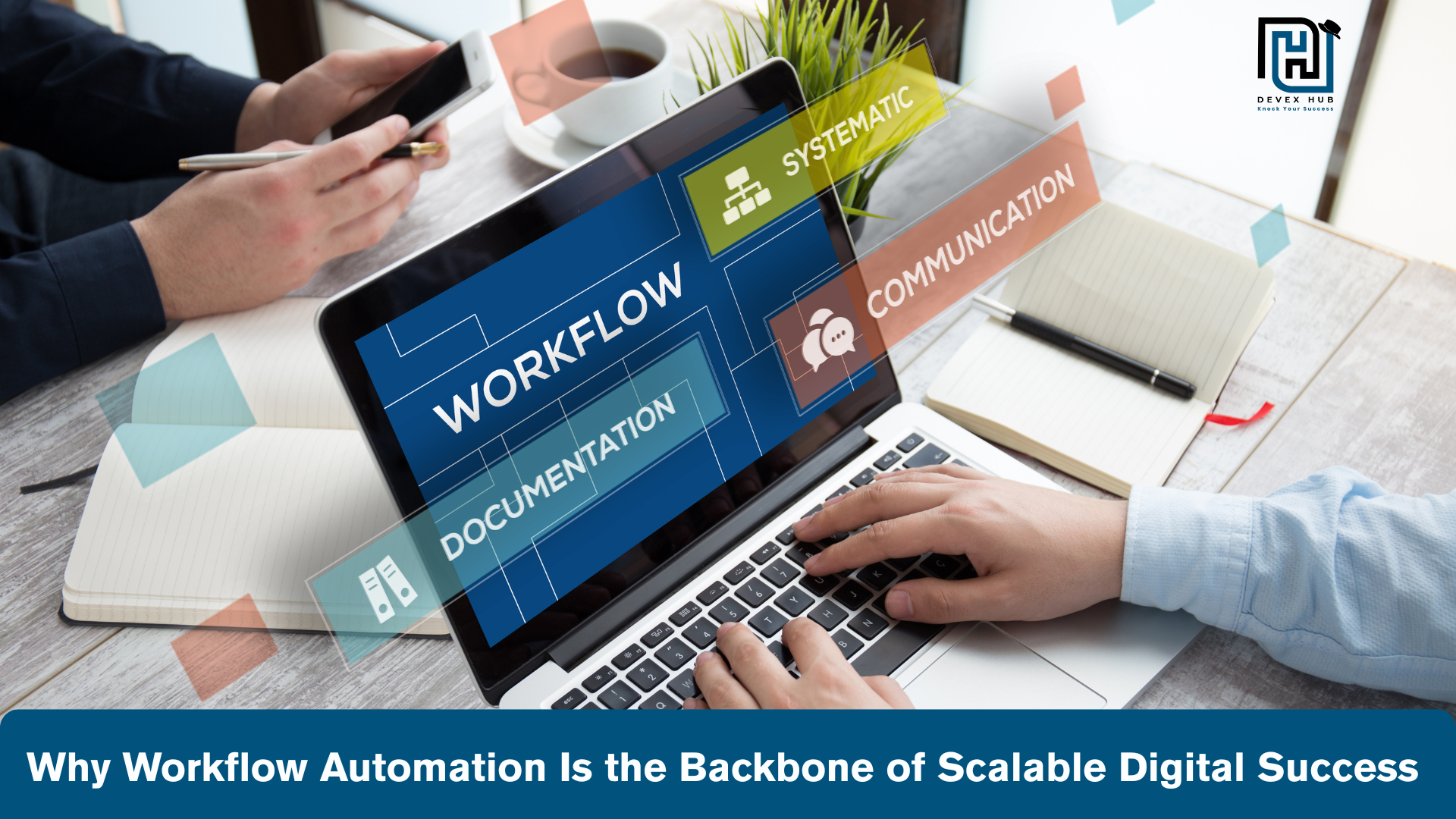
In today’s digital world, growth and scalability are no longer optional — they’re essential. For businesses aiming to expand online, doing more of the same manual tasks simply doesn’t cut it. That’s where workflow automation steps in. At Devex Hub, we believe that automating your workflows is the hidden engine that can power sustainable, scalable digital success.
1. What is Workflow Automation?
Put simply: workflow automation means using technology to handle repetitive tasks, approvals, notifications, data movement and integrations — all without manual intervention.
Instead of copying data from one tool to another, sending the same reminder emails again and again, or waiting for someone to click “Approve”, you set up rules, triggers and connections so the system just “runs”.
For example: when a lead arrives via your website, it is automatically added into your CRM, notified to your marketing team, scheduled for a follow-up, and if no reply after 48 hours an automated reminder kicks in. All without someone manually intervening each time.
2. Why it matters for digital growth
a) Saves time and reduces human error
When you automate workflows, you free up your team from repetitive, low-value tasks. That means they can focus on strategic, creative work. At the same time, automation reduces mistakes — data gets transferred correctly, follow-ups don’t get forgotten, and the process stays consistent.
b) Enables consistent customer experience
Scaling means more customers, more interactions, more touch-points. Without automation you risk inconsistency: slow responses, missed tasks, forgotten follow-ups. With automation you ensure every customer journey is smooth, timely, and high-quality — regardless of volume.
c) Makes scaling manageable
When you grow, your operations and processes must grow too — often rapidly. Manual processes become bottlenecks. Automation offers a way to scale without proportionally increasing resources. Instead of hiring five people to handle 5× leads, perhaps one person and automated systems can manage.
d) Better data & insights
Automated workflows mean data flows through systems cleanly and in real-time. That gives you better visibility into what’s working (and what isn’t). You can track funnels, response times, drop-offs. That insight is gold when you want to optimise for growth.
3. How Devex Hub helps you build this backbone
At Devex Hub, we specialise in not just building websites or running digital marketing campaigns — we help you design systems that power growth. Our services highlight this:
On our Digital Marketing page, we outline how we use tools and automation to boost leads, manage campaigns and track growth. devexhub.com
On our main Services page we reference “Workflow Automation” explicitly as a key offering — connecting systems like CRM, marketing automation, data flows.
We bring together web design/development + digital marketing + automation so you’re not just running campaigns — you’re building scalable infrastructure.
When you partner with us, you’re not just hiring “another agency” to run ads or build a site. You’re getting a partner who helps you build the operational backbone that supports growth.
When you partner with us, you’re not just hiring “another agency” to run ads or build a site. You’re getting a partner who helps you build the operational backbone that supports growth.
4. Key Components of a Scalable Automation System
Here are the building blocks you should focus on when setting up workflow automation:
a) Trigger & action logic
Decide what starts a workflow (trigger) and what happens next (actions). Example: Trigger = “New lead via website form” → Actions: add to CRM, send welcome email, assign to sales, log timestamp.
b) Tool integration
Your marketing, sales, operations systems must talk to each other. Connecting CRM ↔ email marketing ↔ analytics ↔ website is essential. When things are siloed, manual work creeps in.
c) Conditional logic & decision points
Not all leads are the same. You might want “if lead from paid ad → assign priority” or “if no response in X hours → escalate”. Automation needs to include decision logic.
d) Notifications and escalations
Even when things are automatic, humans still need awareness. Setting up notifications, reminders and escalations ensures nothing falls through the cracks.
e) Monitoring & optimisation
Automation is not set-and-forget. You need to monitor flow metrics (time-to-first-touch, conversion rate, processes stuck, etc.), identify bottlenecks, then refine rules.
5. Real-life Example: From Website Visit to Loyal Customer
Imagine you’re a business owner who wants to convert website traffic into long-term customers. Here’s how a scalable automated workflow might look:
Visitor lands on your website and fills a “Free Consultation” form.
Trigger: New form submission → add lead to CRM, tag “Website-Consultation”.
Action: Send automated “Thanks for your interest” email with scheduling link.
Action: Notify sales rep via Slack/Teams with lead details.
Wait 24 hours, check if meeting scheduled. If no → send follow-up reminder email.
After meeting, depending on outcome:
If “Interested” → send proposal, mark status, set reminder for follow-up in 3 days.
If “Not interested” → send feedback survey, tag “lost-cold”, schedule for review next month.
Generate report weekly: number of leads, response time, meeting rate, conversion rate.
Identify bottleneck: If many leads never schedule meeting → perhaps change email copy or shorten scheduling process.
Scale: When volume doubles, system handles majority of tasks automatically — your team focuses on high-value interactions.
That’s the backbone of scalable digital success: a system that works whether you have 10 or 1,000 leads.
6. Top Benefits You’ll See (and When)
Shorter response times: leads are engaged faster → higher conversion chance.
Higher productivity: less admin, more strategy.
Better brand consistency: customers get the same quality experience regardless of volume or who handles it.
Scalable operations: you can grow without equally growing your head-count and manual tasks.
Actionable insights: with clean data flows you see real metrics and can make data-driven improvements.
Reduced costs: less duplication, fewer errors, better ROI on your marketing and operations.
You may realise some benefits almost immediately (e.g., faster response times). Others (optimisation, cost reduction) will build over time as you monitor and refine your workflows.
7. How to Get Started with Devex Hub
Ready to make workflow automation your growth engine? Here’s how we can help:
Audit & strategy: We review your current workflows, tools, gaps and growth goals.
Design & planning: We design the automation architecture — triggers, integrations, decision logic, escalation workflows.
Implementation: We integrate your CRM, website, marketing tools, data pipelines and build automation using industry-standard platforms.
Monitoring & optimisation: We set up dashboards, track KPIs, refine workflows continuously.
Scale & expand: As you grow, we add more automated flows — onboarding, upsells, retention, analytics — so your operations remain efficient.
You can explore our full service offerings at our Services page and reach out for a consultation.
9. Final Word
In a digital landscape where speed, consistency, and scale matter more than ever, workflow automation isn’t just a “nice to have” — it’s the backbone of scalable success. By automating the right workflows, you free your team for high-value work, deliver a superior experience to your customers, and maintain operational control even as things grow.
At Devex Hub, we’re dedicated to helping businesses not only win online but scale online. Let’s build the systems and workflows that support your growth, today and tomorrow.
Ready to take the next step? Contact us and let’s get started.

Comments
Post a Comment