
 Instagram
  Youtube
  Whatsapp
 Multi-Agent AI: Why Businesses Are Moving Beyond a Single Chatbot
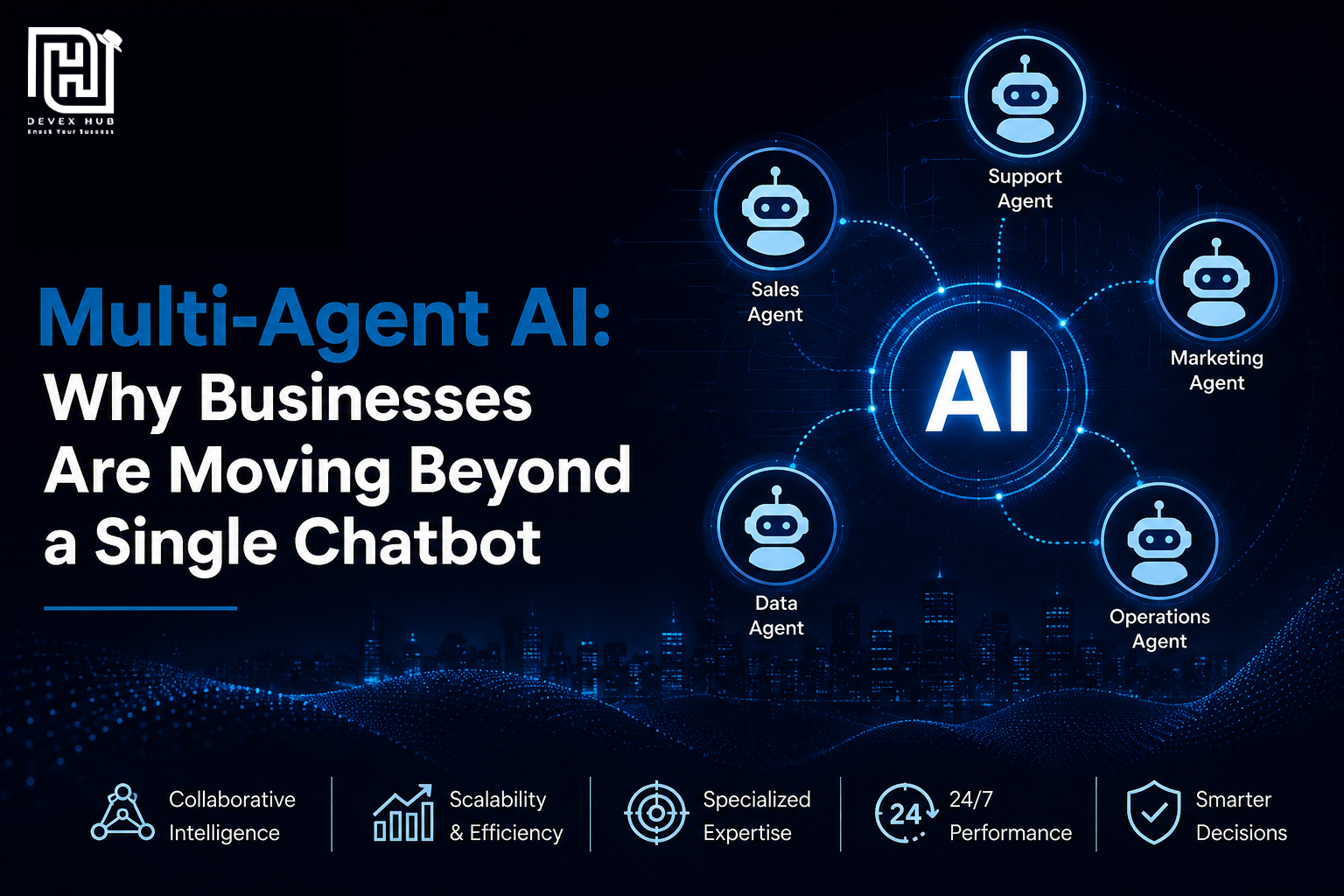
For the last few years, chatbots have been the face of business automation. A single AI assistant sat on a website, answered FAQs, and routed complicated issues to a human. That model worked well enough when expectations were simple. But as businesses push AI deeper into operations, sales, support, and internal workflows, one chatbot trying to do everything is starting to show its limits.
This is where multi-agent AI comes in. Instead of one generalist assistant, companies are now deploying a team of specialized AI agents that work together, each handling a specific task, and coordinating to deliver a complete outcome. It's a shift from "one brain doing everything" to "many brains doing one thing well, together." At DevexHub, we've seen this shift firsthand while working as an AI integration developer for businesses looking to modernize how they handle customer conversations, workflows, and support.
What Is Multi-Agent AI?
Multi-agent AI refers to a system where multiple specialized AI agents collaborate to complete a task, instead of relying on a single model to do it all. Each agent is typically built or fine-tuned for a specific function, for example:
- A research agent that gathers information
- A support agent that handles troubleshooting
- A sales agent that qualifies leads
- A scheduling agent that books meetings
- An AI voice agent that handles inbound and outbound calls, answering questions or booking appointments without a human on the line
- An orchestrator agent that decides which agent should handle which part of the request
These agents communicate with each other, pass along context, and combine their outputs into a single coherent response for the user. The person interacting with the system usually has no idea multiple agents are involved. It just feels faster, smarter, and more accurate.
Why Businesses Are Making the Shift
- Specialization improves accuracy: Just like a company hires specialists instead of one employee for every role, AI agents perform better when they're focused on a narrow task. A dedicated billing agent will handle billing questions more accurately than a generalist bot juggling ten responsibilities.
- Scalability without rebuilding everything: Need a new capability? Add a new agent instead of retraining the entire system. This modular approach makes it far easier to expand what the AI can do over time.
- Better handling of complex workflows: Many business processes aren't single-step. Onboarding a customer, resolving a support ticket, or processing a return often involves multiple steps across different systems. Multi-agent architectures naturally map to these multi-step workflows.
- Improved reliability: If one agent fails or gives an uncertain answer, another agent can validate, correct, or escalate it. This creates a built-in checks-and-balances system that a single chatbot doesn't have.
- Faster resolution times: Agents can work in parallel. While one agent looks up order details, another can check inventory, and a third can draft a response, cutting down the time a customer waits for an answer.
Real-World Applications
Multi-agent AI is already showing up across industries:
- E-commerce: One agent handles order tracking, another manages returns, and a third recommends products.
- Healthcare: Agents manage appointment scheduling, insurance verification, and patient FAQs separately, then combine results into a single patient-facing update.
- Finance: Agents specialize in fraud detection, transaction queries, and compliance checks, working together for a unified customer response.
- Customer support and sales: More companies are adopting AI voice agent services for businesses to handle high call volumes, qualify leads, and answer routine questions around the clock, freeing up human teams for higher-value conversations.
- Internal operations: HR, IT, and finance teams use agent networks to handle employee requests without needing separate tools for each department.
Multi-agent systems don't exist in isolation, either. They usually sit on top of a company's website, CRM, and support tools, which is why the underlying digital foundation matters just as much as the AI layer itself. Businesses investing in professional web design services alongside their AI strategy tend to get more value out of both, since a well-structured, fast-loading website gives AI agents cleaner data to work with and a better experience for the humans who land there.
Challenges to Consider
Multi-agent systems aren't automatically better just because they're more complex. Businesses need to think about:
- Coordination overhead: More agents mean more communication, which needs to be managed carefully to avoid delays or conflicting outputs.
- Cost: Running multiple specialized agents can be more resource-intensive than a single model.
- Governance: Clear rules are needed for how agents hand off tasks, escalate issues, and maintain data privacy across the system.
Businesses that plan for these challenges upfront tend to see far better outcomes than those that adopt multi-agent AI simply because it's trending. Working with an experienced AI integration developer can help avoid many of these pitfalls early, since the architecture decisions made at the start tend to determine how well the system scales later.
Frequently Asked Questions
1. What is the main difference between a chatbot and multi-agent AI?
A chatbot handles every task within a conversation on its own. Multi-agent AI uses multiple specialized agents that work together to solve more complex tasks efficiently.
2. Is multi-agent AI more expensive than a single chatbot?
Yes, it may cost more because multiple AI agents work together. However, the improved accuracy, automation, and efficiency often provide better long-term value.
3. Do customers notice they're interacting with multiple agents?
No. The collaboration happens behind the scenes, so users experience one smooth and seamless conversation without noticing different agents.
4. Which industries benefit most from multi-agent AI?
Industries like e-commerce, healthcare, finance, and customer support benefit the most because they involve complex workflows and multiple decision-making steps.
5. Can small businesses use multi-agent AI, or is it only for large enterprises?
Yes. Small businesses can start with a few AI agents for specific tasks and gradually expand the system as their business grows.
Conclusion
Multi-agent AI represents the next stage in business automation, enabling organizations to handle complex workflows with greater accuracy, flexibility, and efficiency. By combining multiple specialized AI agents, businesses can improve customer experiences, streamline operations, and adapt more easily as their needs evolve. While successful implementation requires the right planning, integration, and governance, the long-term benefits make multi-agent AI a valuable investment for organizations looking to scale their AI capabilities.
If you're exploring AI solutions for your business or want to learn how multi-agent AI can support your operations, contact us to discuss your requirements and discover the right approach for your goals.
.png)

.png)
.jpg)
Comments
Post a Comment